
Reverb is one of the most important effects in digital music production. Beyond its technical purpose, it can also create an emotional sense of distance and memory.
Background Info
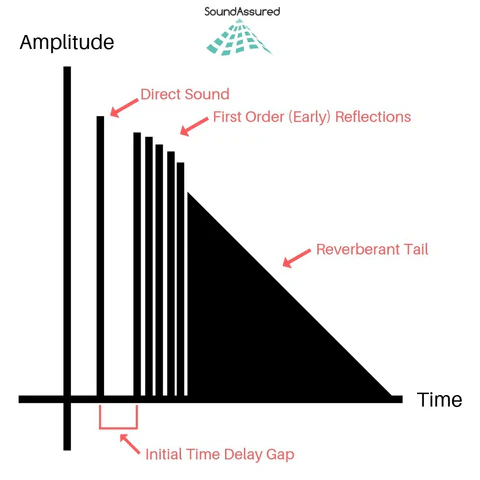
Reverberation is defined in the context of Acoustic Engineering as the phenomenon where a sound is reflected back to the listener via surfaces within a medium (air) and arrives at the same time as the original sound that was emitted directly by a source (such as a speaker). Reverberation is based on the length of time that sound waves bounce around inside a room with its specific dimensions, shapes and surface materials. For instance, an open space such as a cathedral will produce reverberation decays that are longer and smoother than those produced from the shorter and sharper decays found in smaller studios.
Computer software (plugins) allow producers to mimic the effects of acoustic reverberation on digital signals. Many producers employ digital reverb to add a feeling of realism and/or to create a sense of space into their sounds. In addition, digital reverb can alter the emotional content of a sound. Short decay times generally have a contemporary or direct feeling, whereas longer decay times may give a mix a haze or nostalgia.
Technical Insight
Reverb can be simulated in two primary methods; one is called the “algorithmic” method, while the second is referred to as “convolution.” The “algorithmic” method uses a series of digital delay lines connected by filters to model reflections mathematically. On the other hand, the “convolution” method simulates reverb by taking a real-time audio recording of how a very brief impulse (i.e., “the echo”) fades away in a given physical space. This recording is referred to as an “impulse response” (IR) and when convolved with the original signal (dry signal), it combines both in the time-domain creating the illusion of reverb.
Both types of reverbs have parameters that affect the created acoustic illusion. “Pre-Delay” controls how long before the reflections begin. “Decay Time” controls how long the sound remains. Parameters such as “Diffusion,” and “Damping” control the density and frequency absorption of the reflections. A producer may create the impression of distance by slightly filtering sounds that are long in decay time, much like how memories fade with time.
I discovered that using long decay convolution reverbs from large rooms creates a “reflective,” almost “nostalgic” quality while experimenting with convolution reverbs in FL Studio. I also found that automating the wet / dry balance over time allows for the creation of a sense of “breathing,” allowing the sound to move without altering its pitch or rhythm.
Conclusion
Reverb makes a simple sound feel like it has history. The way it combines time, space and tone creates a sound that is both clear and decaying. Reverb adds the audible sensation of memory when there are lingering reflections. With music production, this quality allows for emotion when using a very technical process for sound as well as creating a sense of distance, warmth, and nostalgia all at once.
 Blog
Blog 