
Granular synthesis breaks sound into tiny fragments called grains, each only a few milliseconds long. When arranged procedurally, these grains form evolving textures that feel alive and unpredictable.
Sound in Fragments
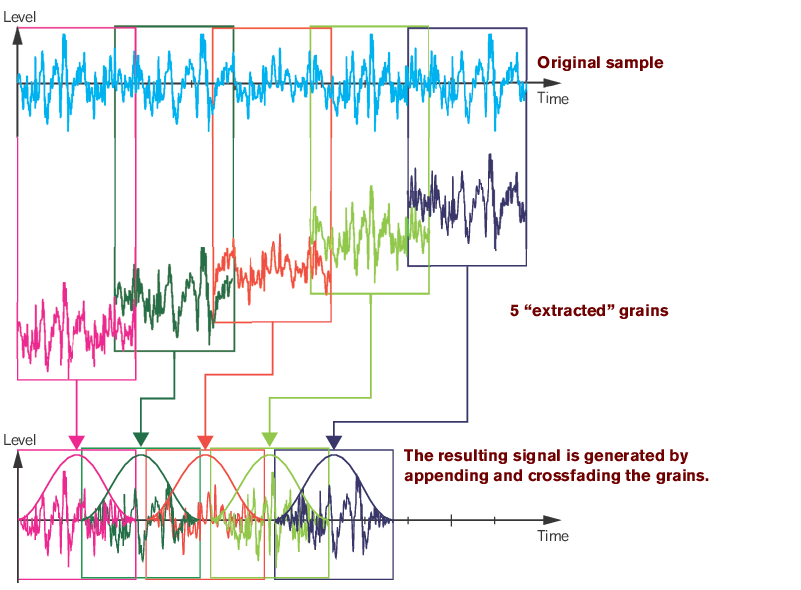
Granular Synthesis in contrast to traditional methods of generating/processing a sound, is based on breaking down an audio sample into granules (grains), which are typically between 10 & 50 milliseconds in length. The granule may then be adjusted by multiple variables; such as its duration, pitch, volume and/or location in space, when combined with other grains, it creates dense groupings of overlapping grains which combine to create new timbre.
The combination of the grain density, grain rate, grain randomness and the sequence of grain playback can dramatically alter the character of the sound. For instance a 5-second vocal sample could become an ambient pad, and a piano note could become a shimmering texture.
Granular synthesis provides the ability for the artist to de-couple the concepts of time and pitch allowing for infinite evolution of the sound without losing the continuity.
From Algorithm to Texture
In procedural granular synthesis the basic method is extended by creating grain parameters automatically or through some form of generation in real-time, instead of static envelopes, the decision of when and how grains are created is determined by algorithmic methods utilizing either probability, noise functions, or external data.
This type of granular synthesis is now very popular in modern music software, and game engines with generative systems responding to movement, environment or user input, for example a soundscape in a video game could be adapting the density of the texture of the soundscape to the players speed or the players surroundings.
Also in procedural synthesis the grain can be controlled using data streams such as; sensor input, random values, or midi events to create dynamic texture.
Ultimately this will allow the creation of a completely unique audio processing system that has all the characteristics of a living organism, with a continuous evolution in character and thus producing continuous evolving sound fields that will never be identical.
Applications in Creative Audio
Procedural granular synthesis is used in film scoring, interactive installations, ambient music, and real-time sound design. Because it can transform small audio samples into complex textures, it is ideal for creating immersive atmospheres and adaptive soundscapes.
By combining computation and acoustics, granular synthesis demonstrates how digital systems can recreate the organic unpredictability of nature. Each generated sound exists somewhere between control and chaos, bridging scientific modeling and creative expression.
 Blog
Blog 