Bézier curves are a simple mathematical tool that can bring visual motion to life. By controlling their shape and timing, it’s possible to create animations that flow with a sense of rhythm similar to music.
Info
Bézier curves provide a method for mathematically interpolating a smooth pathway between points in order to visually define a transition, object pathway or easing function in digital art and animation. The reason why Bézier curves are so effective at creating the qualities of rhythm and motion is their ability to smoothly illustrate acceleration and deceleration characteristics.
Visual rhythm is the result of a combination of repetition and variation which when working together produce flow. Bézier based animation does this by mimicking natural movement as opposed to animation being created with a constant rate of speed and/or consistent spacing. This principle can be applied to many different mediums including motion graphics, particle systems and generative installations.
Implementation and Process
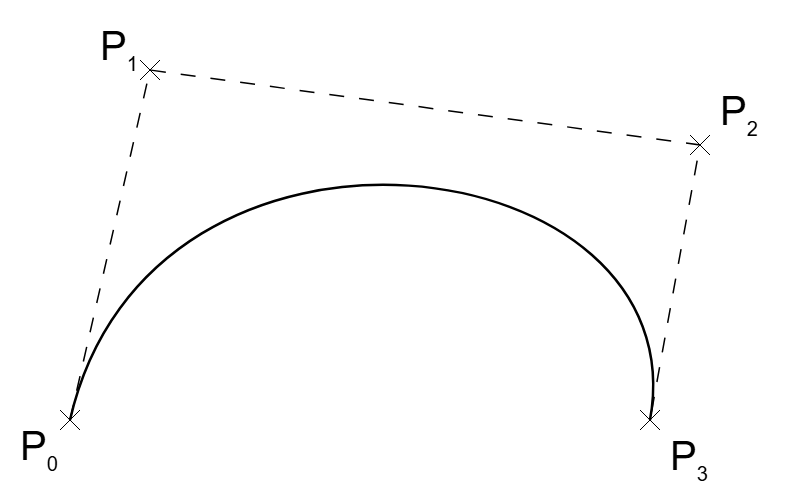
When animating using Bézier curves you are able to manipulate two factors; timing & directionality (position) in which the object will move along the curve. The Bézier curve itself is controlled by control points that pull the curve toward them. Changing the placement of the control points affects not only the visual shape of the curve but how the object will perceive its motion as well.
For my experiment I used cubic Bézier functions to control particle systems in Unity. To generate this wave effect, I sampled the curve at various times to generate a smooth acceleration of the particles followed by a smooth deceleration of the same particles based on a rhythmically determined pattern. When I added the ability to synchronize the particle motion with the amplitude of the sound (higher beats would cause the curve to increase its tension), the animation appeared more alive and responsive than before.
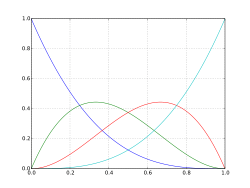
Bézier interpolation allows for smooth easing of an object’s motion rather than the “mechanical” look of a linearly moving object. This creates a breathing like motion where there is no constant velocity and has the visual quality of musical phrasing.
Conclusion
Bézier curves turn geometry into movement that feels intentional. Their smooth transitions make rhythm visible, allowing animations to pulse and flow in time with design or sound. By combining precise control with organic motion, Bézier-based animation bridges mathematics and art, revealing how even the simplest equations can express tempo and emotion through visual form.
 Blog
Blog 